
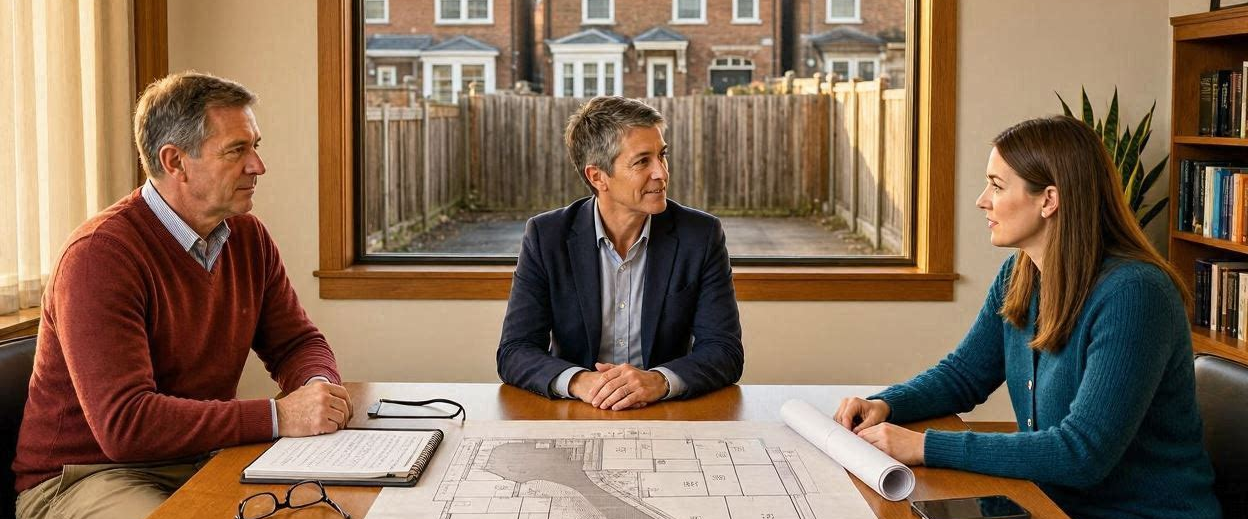
Boundary and access disputes can become highly emotional. What may begin as a simple disagreement over a fence, hedge, driveway, or right of way can quickly escalate into a long-running conflict that affects daily life and neighbourly relationships.
These disputes can also be costly if they progress to court. Mediation offers a confidential and constructive alternative, helping those involved reach practical solutions without the expense, delay, and uncertainty of litigation.
At MK Mediation, I provide an impartial and structured process that allows everyone to explain their concerns, explore the issues, and work towards an agreement that is acceptable to all parties.
Boundary & Access Disputes Mediation
Helping neighbours and property owners resolve boundary and access disputes
What boundary and access disputes can mediation help resolve?
Mediation can assist with a wide range of property-related disagreements, including:
✅ Boundary disputes
- Disagreements over the location of boundary lines, fences, walls, hedges, or other dividing features between neighbouring properties.
✅ Rights of way and access disputes
- Issues involving shared driveways, private roads, footpaths, easements, and access to land or property.
✅ Encroachment disputes
- Concerns where buildings, extensions, fences, trees, or other structures are believed to extend onto neighbouring land.
✅ Shared access arrangements
- Disagreements about the use, maintenance, or obstruction of shared entrances, pathways, parking areas, or driveways.
✅ Neighbour disagreements affecting property use
- Helping neighbours resolve ongoing disputes before positions become entrenched and relationships deteriorate further.
Why choose mediation?
Boundary disputes often involve people who will continue living next to each other long after the dispute has ended. Mediation focuses not only on resolving the immediate issue but also on improving communication and reducing future conflict.
Benefits of mediation include:
✔ Faster than court proceedings
- Court cases involving property disputes can take many months or even years. Mediation provides an opportunity to resolve issues much sooner.
✔ Cost-effective
- Resolving a dispute through mediation can significantly reduce legal costs and the financial uncertainty of litigation.
✔ Confidential
- Everything discussed during mediation remains private, allowing parties to have open and honest conversations.
✔ Greater control
- Rather than having a decision imposed by a judge, the parties work together to find a practical solution that meets their individual circumstances.
✔ Preserving neighbour relationships
- Where possible, mediation helps rebuild communication and encourages solutions that make living alongside one another easier in the future.
How boundary and access mediation works
Every dispute is unique, but the mediation process generally follows four simple steps:
1. Initial consultation
I speak with each party to understand the nature of the dispute and explain how mediation works.
2. Preparation
Each party has the opportunity to provide information and identify the issues they wish to discuss.
3. Mediation session
The parties meet in a structured and respectful environment, guided by an independent mediator who facilitates constructive discussion.
4. Reaching an agreement
Where common ground is found, the parties can agree practical solutions and record these in a written agreement.
Resolve property disputes before they escalate
Many boundary and access disputes arise through misunderstandings, poor communication, or differing interpretations of property boundaries and rights. Addressing these issues early can often prevent lengthy legal proceedings and help neighbours move forward with greater certainty.
Whether your dispute involves a boundary, shared access, a right of way, or another property-related issue, mediation provides a practical opportunity to resolve matters constructively.